


CNC Machining: Precision Manufacturing of Ultra-Large Parts
As industrial equipment, aerospace systems, energy infrastructure, and advanced machinery continue to grow in size and complexity, manufacturers increasingly require CNC machining for ultra-large parts. Unlike conventional CNC machining, producing an oversized component requires careful control of machining accuracy, machine stability, workholding, tool access, thermal effects, and dimensional inspection.
Ultra-large CNC machined parts may include large structural components, machine bases, housings, frames, mold plates, shafts, flanges, tooling, and other critical components. These parts often combine large dimensions with complex geometries and demanding dimensional requirements.
For manufacturers, the challenge is not simply finding a CNC machine large enough to hold the workpiece. The entire manufacturing process must be engineered around the size, weight, material, geometry, and accuracy requirements of the component.
What Is Ultra-Large Part CNC Machining?
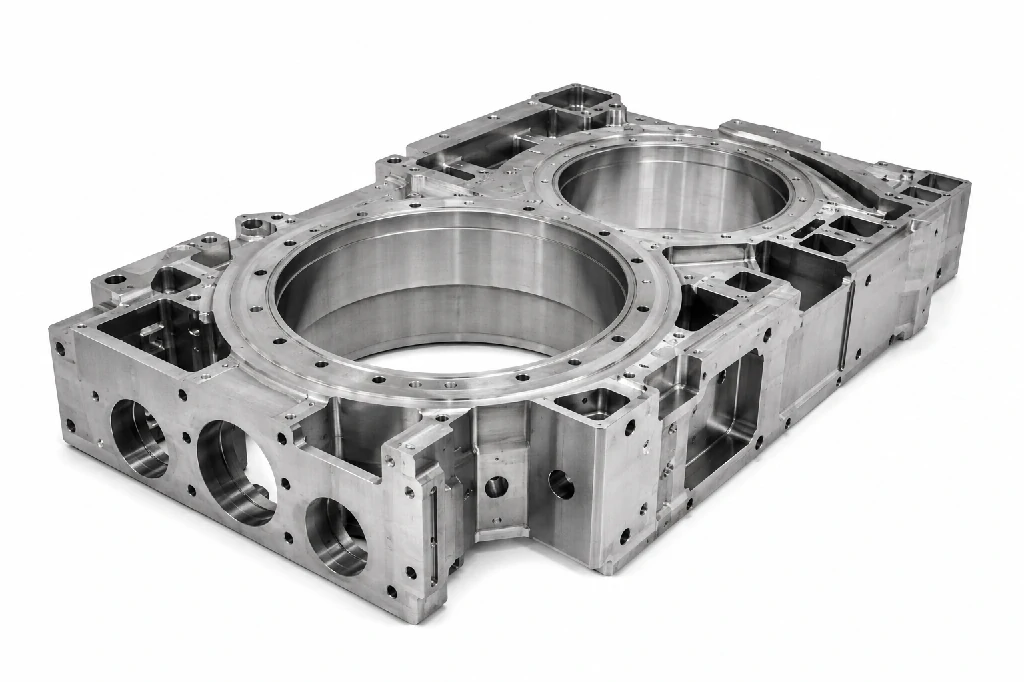
Ultra-large part CNC machining is the precision machining of oversized components that exceed the typical working envelope of conventional CNC machining centers.
Depending on the manufacturer and equipment, large-part machining can involve components measuring several meters in length or width and weighing hundreds or thousands of kilograms. Specialized equipment such as large-format machining centers, gantry mills, horizontal boring mills, and multi-axis CNC machines may be required.
The objective is to achieve the required dimensional accuracy, geometric tolerances, surface finish, and functional features across the entire component—not just within individual machining areas.
This makes large-part machining fundamentally different from simply machining a larger version of a standard component.
Why Is CNC Machining Large Parts Challenging?
As part dimensions increase, relatively small manufacturing variables can have a much greater effect on the final result.
1. Machine Size and Working Envelope
The CNC machine must provide sufficient X, Y, and Z travel to accommodate the workpiece while maintaining adequate clearance for tooling and fixtures.
Large-format machining centers and gantry-type CNC machines are often used for oversized components because they provide substantially larger working envelopes than standard vertical machining centers.
Machine rigidity is equally important. A large component can generate significant cutting forces, particularly when machining steel, stainless steel, titanium, or other difficult-to-machine materials.
2. Workholding and Part Stability
Supporting a large component correctly is one of the most important aspects of precision large-part machining.
An oversized workpiece can deform under its own weight. Improper support may cause the part to move or distort during machining, resulting in dimensional errors after the component is removed from the fixture.
Manufacturers therefore need to consider:
- Workpiece weight and center of gravity
- Support-point locations
- Fixture rigidity
- Clamping forces
- Part deformation
- Accessibility of machining surfaces
- Repositioning requirements
For extremely large components, workholding is often engineered specifically for the individual part.
3. Thermal Stability
Temperature can become a significant factor when machining large components.
Machine structures, cutting tools, fixtures, and workpieces can all experience thermal expansion. When machining a small component, these changes may be relatively insignificant. Across a very large part, however, small thermal variations can accumulate into measurable dimensional differences.
Precision large-part manufacturing may therefore require:
- Controlled shop-floor temperature
- Machine warm-up procedures
- Thermal compensation
- Stable cutting parameters
- Temperature monitoring
- Intermediate inspection
Thermal behavior is particularly important when components have long dimensions or demanding geometric tolerances.
4. Tool Reach and Cutting Strategy
Large parts frequently contain deep pockets, long walls, large cavities, angled surfaces, or difficult-to-access features.
Long-reach tooling may be required, but increasing tool length can also reduce rigidity and increase vibration.
For this reason, CNC programmers must carefully balance:
- Tool diameter
- Tool length
- Cutting depth
- Feed rate
- Spindle speed
- Tool engagement
- Step-over
- Cutting direction
- Roughing and finishing strategies
For complex geometries, multi-axis machining can reduce the number of setups and improve access to multiple surfaces.
CNC Processes Used for Ultra-Large Parts
Different large components require different machining processes.
Large CNC Milling
Large-format CNC milling is commonly used for plates, frames, housings, machine bases, structural components, tooling, and other prismatic parts.
Large milling machines can perform operations such as:
- Face milling
- Pocket milling
- Slotting
- Drilling
- Tapping
- Contouring
- Chamfering
- Surface finishing
For large flat components, maintaining flatness and parallelism across the entire surface can be a major manufacturing consideration.
5-Axis CNC Machining
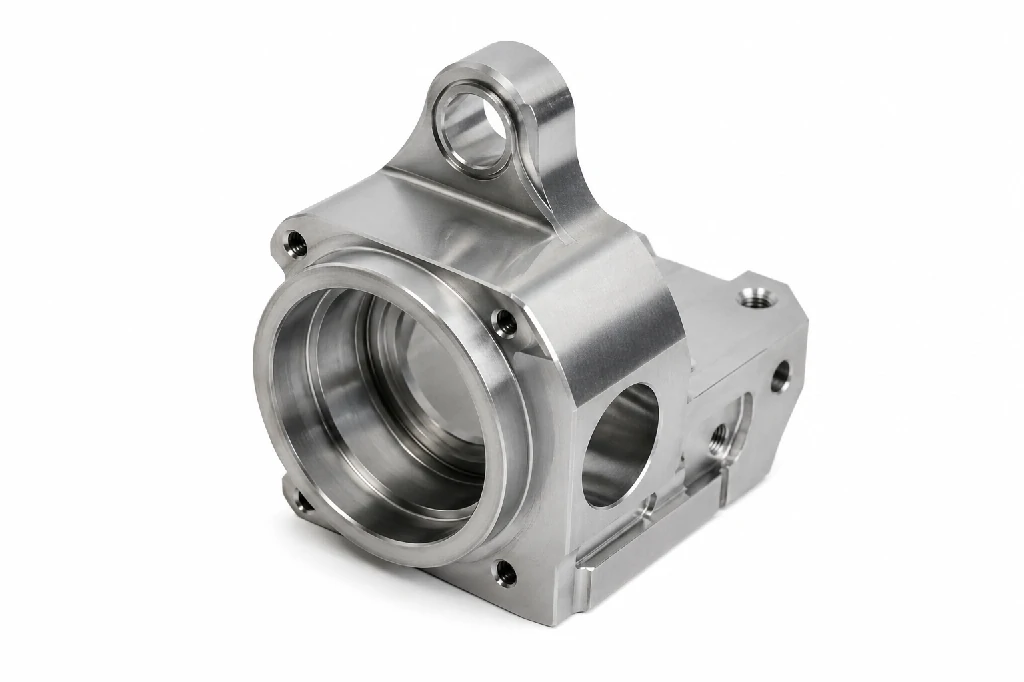
5-axis CNC machining can be particularly useful when large components contain complex surfaces or features on multiple faces.
Instead of repeatedly repositioning a component, a multi-axis machine can orient the cutting tool to reach different surfaces and angles. Reducing setups can help minimize alignment errors and improve manufacturing efficiency.
5-axis machining is commonly associated with complex aerospace components, freeform surfaces, structural parts, and other geometrically demanding applications.
CNC Turning for Large Components
For large rotational components, CNC turning or horizontal/vertical turning can be used to manufacture:
- Large shafts
- Flanges
- Cylindrical housings
- Rings
- Rollers
- Rotating equipment components
Large turning applications require careful control of workpiece balance, chucking, tool stability, and cutting forces.
CNC Boring
Large boring operations are used when components require highly accurate internal diameters, bores, or intersecting holes.
Horizontal boring mills can be particularly valuable for large housings and industrial components where precise hole location and alignment are critical.
Materials for Ultra-Large CNC Machined Parts
Ultra-large components can be manufactured from a wide range of engineering materials depending on their application.
Aluminum
Aluminum is widely used where low weight, corrosion resistance, and good machinability are important.
Typical applications include:
- Aerospace structures
- Large tooling
- Transportation components
- Machine structures
- Prototypes
Steel
Steel provides high strength, rigidity, wear resistance, and durability.
Large steel components are commonly used in:
- Industrial machinery
- Heavy equipment
- Energy systems
- Tooling
- Structural applications
Stainless Steel
Stainless steel combines corrosion resistance with mechanical strength and is often selected for demanding industrial environments.
Titanium
Titanium provides an excellent strength-to-weight ratio but can be significantly more challenging to machine than aluminum or conventional steels.
It is commonly associated with aerospace and other high-performance applications.
Engineering Plastics
Large CNC components can also be manufactured from engineering plastics such as:
- PEEK
- Delrin
- Nylon
- UHMW
- Polycarbonate
These materials can be useful for lightweight components, electrical insulation, chemical resistance, wear applications, and prototypes.
Quality Control for Large CNC Machined Parts
Maintaining precision across a large component requires more than inspecting a few individual dimensions.
A comprehensive inspection strategy may include:
- Dimensional inspection
- GD&T verification
- CMM inspection
- Surface roughness measurement
- Flatness inspection
- Parallelism inspection
- Position tolerance verification
- Hole diameter inspection
- First article inspection
- Final inspection reports
For large and complex components, coordinate measuring machines and other metrology systems can verify critical dimensions against the original CAD model.
Large-part manufacturers may also use inspection at multiple stages rather than waiting until the end of production. This approach can identify dimensional deviations earlier and reduce the risk of producing an entire component outside specification.
Applications of Ultra-Large CNC Machining
Large CNC machining supports many industries where oversized precision components are required.
Aerospace and Space
Aerospace manufacturing often requires large structural components with complex geometries and demanding dimensional requirements.
Potential applications include:
- Aircraft structural components
- Wing structures
- Bulkheads
- Frames
- Landing gear components
- Aerospace tooling
- Satellite structures
CNC machining is widely used in aerospace because it can produce complex components with consistent dimensional accuracy and repeatability.
Energy
Large CNC machining is also important in conventional and renewable energy applications.
Components may include:
- Turbine housings
- Pump housings
- Compressor components
- Generator components
- Large shafts
- Structural equipment components
Industrial Equipment
Industrial machinery often requires large bases, frames, housings, mounting plates, and structural components.
CNC machining allows these components to be manufactured from solid materials or large blanks while maintaining controlled dimensions and interfaces.
Heavy Machinery
Construction, mining, material handling, and other heavy-equipment industries can require large precision components capable of handling high loads and harsh operating conditions.
Robotics and Automation
As industrial automation systems become larger and more integrated, manufacturers may require large machined frames, mounting structures, robotic components, and custom tooling.
Advantages of CNC Machining for Ultra-Large Parts
Compared with manufacturing large components through multiple smaller pieces and joining them together, machining a component from a single large workpiece can offer several potential advantages.
Improved Structural Integrity
A monolithic machined component can reduce the number of welded or mechanically joined interfaces.
Better Dimensional Consistency
Machining critical interfaces in a single component can help maintain the positional relationship between features.
Complex Geometries
CNC machining can produce pockets, contours, holes, threads, angled surfaces, and complex profiles that may be difficult to manufacture using conventional fabrication methods.
Reduced Assembly
When multiple components can be consolidated into one machined part, the number of assembly operations can potentially be reduced.
Repeatability
Once the machining process has been validated, CNC production can provide consistent results across multiple parts.
How to Improve the Accuracy of Ultra-Large CNC Machining
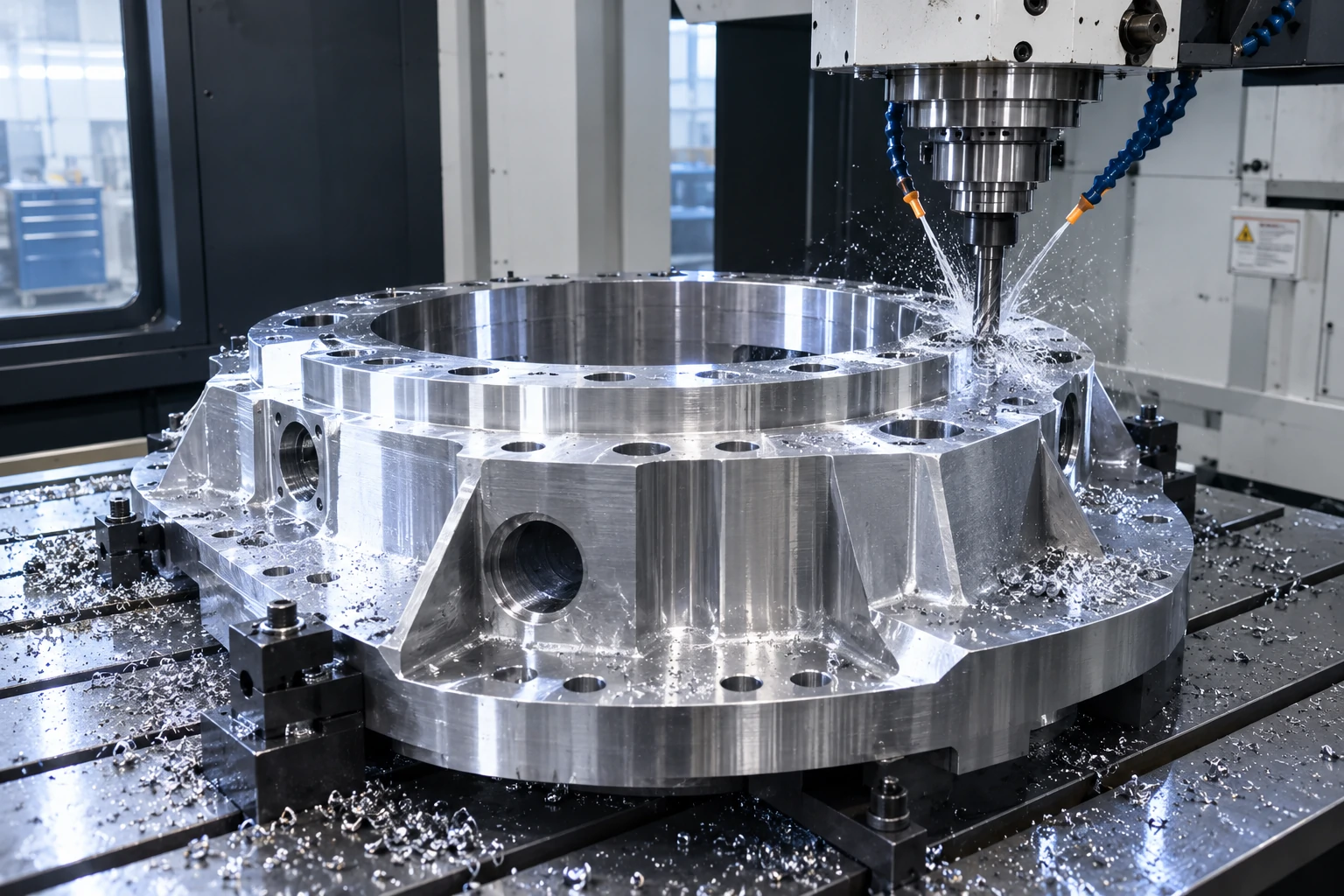
Achieving precision at a large scale requires a process-oriented approach.
Optimize the Part Design
Design engineers should consider machining accessibility, tool clearance, wall thickness, internal corners, datum structures, and workholding requirements during the design stage.
Design for manufacturability can reduce unnecessary machining operations and make large components easier to produce.
Minimize Unnecessary Setups
Every time a large component is repositioned, there is a potential source of alignment error.
Where practical, manufacturers can use multi-axis machining or carefully designed fixtures to reduce the number of setups.
Control Cutting Forces
Aggressive machining strategies can create vibration, deformation, and excessive tool wear.
Optimized roughing and finishing strategies help maintain stability while balancing machining time and surface quality.
Use In-Process Inspection
Inspecting critical features during production can help identify deviations before the entire part is completed.
Maintain Machine and Environmental Stability
For precision large-part machining, machine calibration, thermal stability, fixture rigidity, and environmental control can all influence the final result.
What to Consider When Choosing a Large Part CNC Machining Supplier
Not every CNC machining supplier is equipped to manufacture ultra-large components.
Before selecting a manufacturing partner, consider the following factors:
Machine Capacity
Check the maximum machining envelope, table size, maximum workpiece weight, and axis travel.
Precision Capability
Ask how the manufacturer controls dimensional accuracy, geometric tolerances, thermal effects, and machine calibration.
Multi-Axis Capability
For complex large components, 4-axis or 5-axis machining may provide better accessibility and reduce the number of setups.
Material Experience
The supplier should have proven experience machining your specific material, especially if you require titanium, hardened steel, stainless steel, or engineering plastics.
Inspection Capability
Ask whether the manufacturer provides CMM inspection, GD&T verification, dimensional reports, or other quality documentation.
Engineering Support
Large components often require more engineering input than standard CNC parts. A capable supplier should be able to review the CAD model and drawings, identify manufacturing risks, and recommend appropriate machining strategies.
CNC Machining for Ultra-Large Parts at QSY
At QSY, we provide custom CNC machining solutions for complex components and demanding manufacturing applications.
Our CNC machining capabilities support different production requirements, from prototypes and low-volume production to larger production programs. By combining CNC milling, turning, multi-axis machining, engineering support, and quality inspection, we help customers transform large and complex CAD designs into finished components.
For ultra-large or oversized components, the manufacturing process starts with understanding the part's dimensions, material, tolerances, geometry, and application requirements.
Our engineering team can review your drawings and 3D CAD files to determine an appropriate machining strategy, including workholding, tooling, machining sequence, surface finishing, and inspection requirements.
Whether you need a large structural component, industrial housing, tooling plate, machine base, shaft, or another oversized precision component, selecting the right machining process is critical to achieving reliable results.
Conclusion
Ultra-large part CNC machining combines large-scale manufacturing capacity with precision machining technology. As component dimensions increase, factors such as workholding, machine rigidity, thermal stability, tool accessibility, cutting strategy, and inspection become increasingly important.
With appropriate equipment, experienced CNC programmers, optimized machining processes, and rigorous quality control, manufacturers can produce large and complex components with the dimensional accuracy and repeatability required by modern industries.
For aerospace, energy, industrial equipment, robotics, heavy machinery, and other demanding applications, precision large-part CNC machining provides a flexible solution for manufacturing oversized components with complex features and critical interfaces.
If you have a large or ultra-large component that requires CNC machining, provide your 3D CAD model, technical drawings, material specifications, and tolerance requirements for an engineering review and manufacturing quote.
FAQ
What is ultra-large part CNC machining?
Ultra-large part CNC machining is the precision machining of oversized components that require specialized large-format CNC equipment, workholding, tooling, and inspection methods.
What industries use large-part CNC machining?
Large-part CNC machining is widely used in aerospace, space, energy, industrial equipment, heavy machinery, robotics, transportation, and other industries requiring oversized precision components.
What machines are used for large CNC machining?
Large CNC machining may use gantry mills, large machining centers, horizontal boring mills, large CNC lathes, and multi-axis CNC machines depending on the component geometry and manufacturing requirements.
What materials can be used for ultra-large CNC parts?
Common materials include aluminum, steel, stainless steel, titanium, and engineering plastics. The appropriate material depends on the component's strength, weight, corrosion resistance, operating environment, and application.
How do manufacturers maintain accuracy when machining large parts?
Accuracy can be controlled through rigid workholding, optimized machining strategies, thermal management, machine calibration, minimized setups, in-process inspection, and final dimensional verification.
Can 5-axis CNC machines be used for large parts?
Yes. Large 5-axis CNC machining can be useful for complex components with multiple angled surfaces and freeform geometries because it can reduce setups and improve tool access.